Mr. Wickfield's house
David CopperfieldMr. Wickfield's house is an old Canterbury home whose ordered, welcoming interior gives David a refuge after years of instability. It is also the setting where he first meets Agnes and begins to associate the household with calm, learning, and the possibility of becoming a boy at ease among others.
Setting and First Impressions
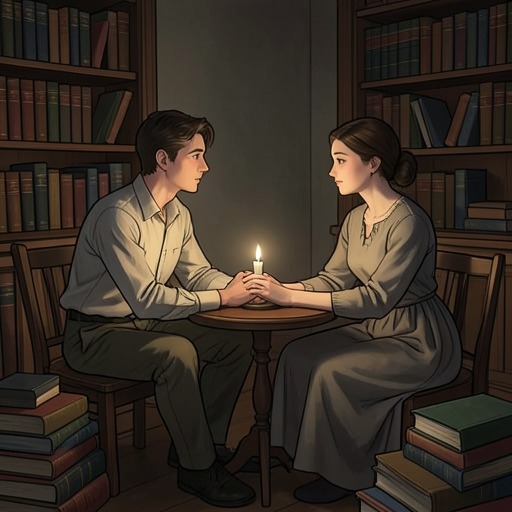
The house announces its age through its architecture and its quiet, cared-for rooms. A broad old staircase leads to a shady drawing-room lit by three or four quaint windows; oak seats, a shining floor, and great ceiling beams give the room a continuity with the timber around it. Red and green furnishings, flowers, and a succession of small tables, cupboards, bookcases, and seats fill its corners. The abundance of these intimate recesses makes the room feel both distinctive and composed, while cleanliness and quiet mark the household as a contrast to the disorder David has known.
When Mr. Wickfield introduces David to his daughter Agnes, she comes quickly from a corner door and kisses her father. David recognizes in her face the calm expression of the portrait he had noticed downstairs, as though the painted image had grown into a woman while Agnes herself remained a child. Her basket of keys identifies her as the housekeeper, but David’s first impression extends beyond domestic competence: he sees in her a tranquil, good spirit. On the staircase, her brightness recalls to him a stained-glass window, an association that becomes part of the way he remembers her and the house.
The arrangement made for David to live there pleases both him and his aunt. Agnes promises that Mr. Wickfield will arrange what he needs and offers him kind words and advice before he settles into his room. Later, returning from school with his books, David finds that knocking at the house softens his uneasiness: the shadow of the staircase seems to quiet his doubts, and he sits down to study with renewed hope. The home’s importance thus lies not only in its old rooms but in the welcome and routine they provide.
Domestic Routine and Learning
The house’s welcome is sustained by a daily routine in which Agnes Wickfield attends to both her father and David. After dinner she sets out the glasses and decanters while Mr. Wickfield drinks; she then plays the piano, sits and works beside him, talks with him, and joins David in games of dominoes. Later she makes tea and looks over David’s books, modestly presenting her help as slight even though she knows how to explain their contents and show him how best to understand them. The drawing-room is therefore not simply a refuge from school: it is a place where care, companionship, and study are woven into the same domestic evening.
That routine also gives the house a more complicated character. Agnes’s quiet attentiveness surrounds Mr. Wickfield’s substantial drinking without removing it; the calm order of the rooms coexists with a vulnerability inside the household. For David, however, the strongest impression is Agnes’s influence. He distinguishes his affection for her from romantic love, yet associates her presence with goodness, peace, and truth, extending the stained-glass brightness he first imagined on the staircase to the life of the house around her. The home’s restorative effect thus rests not only on its old architecture and hospitable welcome, but on Agnes’s steady work within it.
A Refuge from Earlier Hardship
The house’s welcome acquires particular force against the shame David carries from his earlier life in London. On his first day at Doctor Strong’s school, he worries that his new schoolfellows might recognize his connection with the Micawbers: the visits to the King’s Bench Prison, the pawning and selling of household possessions, and the struggle to scrape together halfpence for simple meals. He shrinks from friendly approaches, afraid that his manner will betray the experiences that set him apart. Returning to Mr. Wickfield’s house with his schoolbooks, he finds those anxieties easing; its calm domestic life offers a counterweight to the precarious world he has survived, and a place where his attention can turn from concealment toward study and hope.
Domestic Authority and Contrast
The house’s ordered care also throws David’s earlier experience of domestic authority into relief. At Blunderstone Rookery, Miss Murdstone takes Clara Copperfield’s keys, keeps them under her pillow at night, and assumes control of household decisions; when Clara protests that she should have been consulted, Edward Murdstone invokes his doctrine of firmness to silence her. David’s lessons at home likewise become a means for the Murdstones to discipline both mother and child. At Mr. Wickfield’s house, Agnes’s keys hang from her own small basket, and her work as housekeeper is joined to practical kindness: she welcomes David, guides him to his room, and later helps him understand his books. The parallel does not erase the limits of domestic life, but it makes the house’s care legible as a different kind of authority—one expressed through welcome and assistance rather than imposed obedience.
The distinction matters in the wider sequence of David’s childhood. Sent to Salem House during the holidays as punishment, he first encounters schooling in a bare, neglected building; after his mother’s death, at ten, he is put to work at Murdstone and Grinby’s warehouse among bottles, labels, and rats. Against those punitive and exploitative settings, Mr. Wickfield’s house offers a place where learning is supported rather than used to humiliate him. Its quiet staircase and lived-in rooms do not undo what he has endured, but they mark a change in the conditions under which he can study and grow. The house consequently functions as more than shelter: it gives David an early experience of domestic order made humane through Agnes’s attention.